


Tank Blanketing for Small Molecule API Production
Application: Upstream – Small Molecule API – Reactor & Product Hold Vessel Blanketing
Media: Nitrogen (N2) blanket gas over volatile, toxic solvents and reactive chemistry
Valve Requirement: Low-pressure padding (PRV) on the supply line and de-padding (BPRV) on the vent line
Inert gas blanketing is a foundational safety and quality control in pharmaceutical manufacturing. The following case study follows a real selection made at an FDA-approved CDMO that develops and produces complex Active Pharmaceutical Ingredients (APIs), including Anti-body-Drug Conjugates (ADCs) and high-potency APIs (HPAPIs).
The company acquired an older small molecule API facility and upgraded it for their process. In the new layout, solvents are dispensed from storage, precisely weighed, and blended with solid chemistry. The resulting proprietary slurry is pumped into ventilated clean-room reaction vessels, where compounds are formed under controlled pressure and temperature. The reactor output is then purified by chromatography to yield the finished API. To protect operators, product, and facility at every step, the storage tanks, reactors, and downstream hold vessels are all blanketed with nitrogen.
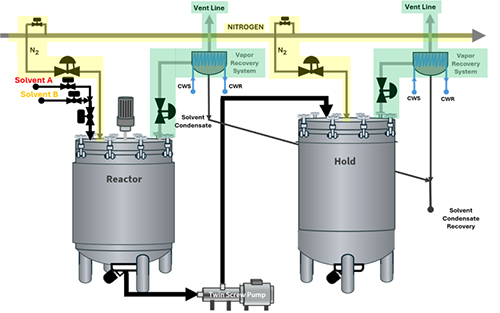
Below is a simplified blanketing layout – nitrogen padding supply (yellow) maintains the inert blanket while the vent / vapor-recovery line (green) relieves excess pressure on both the reactor and product hold vessels.
Why Inert Gas Blanketing Is Required
This production process uses highly volatile, toxic solvents alongside reactive solid chemicals. Extreme care is needed at every step to prevent operator exposure, protect the product from air and airborne contaminants, and stop flammable solvent vapor from escaping into the atmosphere.
To achieve this, the solvent storage tanks, reactors, and downstream process vessels are blanketed with an inert gas – typically nitrogen – that holds a stable, slightly positive pressure in the vapor space above the liquid. This keeps oxygen out, contains hazardous vapors, and prevents a flammable headspace from forming. Final product distribution lines feeding bulk filling or final formulation may also be purged with nitrogen.
Two Types of Valves Are Used in Pharma Blanketing
The CDMO selected Steriflow pharma-grade blanketing regulators for its reactors and product hold tanks. Every blanketing loop relies on a complementary pair of valves working together:
- Pressure Reducing Valves (PRVs) on the nitrogen supply line – often called padding valves
- Back Pressure Regulating Valves (BPRVs) on the vent line – often called de-padding valves
The padding valve adds gas when headspace pressure falls; the de-padding valve relieves gas when headspace pressure rises. Together they hold the blanket within a narrow band between the two set points.
The Padding Valve (PRV)
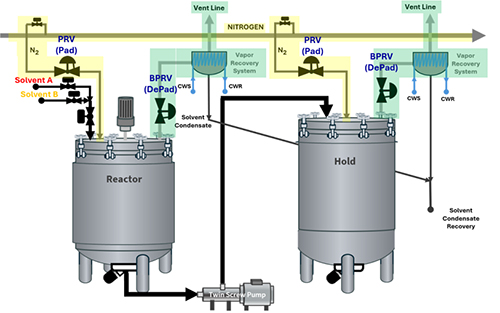
A PRV controls the flow of nitrogen into the vessel’s vapor space, ensuring the inert blanket is maintained at a specific pressure over the volatile contents at all times. Functionally, it adds gas whenever headspace pressure drops below its set point – for example, as liquid is pumped out or as cooling contracts the vapor space. Two different PRVs were selected here because the two vessels operate at very different pressures.
The below figure shows the padding valves (PRV) sit on the nitrogen supply line, feeding each vessel’s vapor space to hold the blanket at set point
Reactor Vessel – Steriflow Valve’s JSRLP Series
The reactor operates at higher pressure and was blanketed with nitrogen at 15 psig (1 barg) at a flow rate of 0.1-0.7 SCFM (2.8-19.8 LPM). The PRV selected was Steriflow’s very compact JSRLP Series, with a 5.70″ diameter spring housing, a Jorlon PTFE diaphragm, and a PTFE seat. The JSRLP handles the 100 pisg (6,9 barg) nitrogen inlet pressure and supports outlet set points >0.5 psig (35 mbar).
Product Hold Vessel – Steriflow Valve’s JSRULP Series
The product hold vessel was blanketed at a much lower 8″ WC (20 mbar) at a similar flow rate. The PRV selected was Steriflow’s compact JSRULP Series, with a 9.5″ diameter spring housing, a Jorlon PTFE diaphragm, and a PTFE seat. It also handles the full 100 psi (6,9 barg) inlet pressure while maintaining an outlet set point as low as 3″ WC (7.5 mbar).
The De-Padding Valve (BPRV)
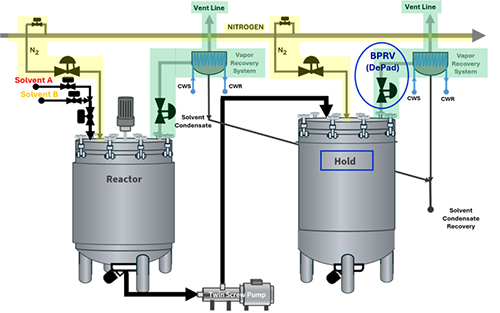
A BPRV relieves gas from the vessel’s vapor space whenever pressure rises above its setpoint – for example, as liquid is pumped in or as a vessel warms. It also closes when pressure falls below that set point, such as when the reactor contents are pumped out, so the blanket is never wastefully vented. Two different BPRVs were chosen to match the two vessels.
The below image shows the de-padding valve (BPRV) sits on the vent / major-recovery line and relieves excess headspace pressure above its setpoint
Reactor Vessel – Steriflow JSBLP Series
With its PRV supplying nitrogen at 15 psig (1 barg), the reactor needed a BPRV able to handle that flow and relieve at a slightly higher pressure. The relief point was set at 16 psig (1,14 barg), 1 psig above the supply set point. The valve selected was Steriflow’s compact, direct-operated JSBLP Series, with a 5.70″ diameter spring housing, a Jorlon PTFE diaphragm, and a PTFE seat.
Product Hold Vessel – Steriflow Mark 958 Series
The product holds vessel required a nitrogen blanket at 8″ WC (20 mbar) with a flow rate of 0.1-0.7 SCFM (2,8-19,8 LPM). The BPRV selected was Steriflow’s Mark 958 Series, a direct-operated regulator with a 9″ (22,9 cm) diameter spring housing, a PTFE-faced diaphragm, and an FFKM seat. It’s relief set point was set at 13″ WC.
What Information Is Needed to Size and Select Blanketing Regulators
Whether you are sizing a PRV or a BPRV, the following baseline information is required for the application:
- Liquid name
- Liquid storage temperature (minimum, normal, and maximum)
- Liquid vapor pressure
- Vessel volume
- Vessel pump-in and pump-out flow rates
- Vessel insulation
- Vessel location / latitude (for outdoor vessels)
Additional information for the Padding Valve (PRV)
- Inlet pressure (P1): the blanket-gas distribution pressure as it enters the PRV
- Outlet pressure set point (P2): the minimum pressure to maintain at the PRV outlet and in the vapor space above the liquid
- Minimum and maximum gas flow into the vessel: the minimum is typically the flow needed to replace gas lost through the vent while the liquid level is static; the maximum is usually the flow required to replace liquid as the vessel is emptied
Additional information for the De-Padding Valve (BPRV)
- Inlet set pressure (P1): the pressure at which the BPRV opens to relieve vessel pressure, set a few points above the PRV set point (see the guideline table below)
- Outlet pressure (P2): the natural vent-line pressure – usually atmospheric, but possibly a partial vacuum where a vapor-recovery system is used
- Minimum and maximum gas flow out of the vessel: the minimum usually matches the PRV minimum flow; the maximum is the flow displaced out the vent as the vessel is filled
Sizing to API STD 2000
The American Petroleum Institute standard API STD 2000 addresses normal and emergency venting requirements for storage tanks operating from full vacuum through 15 psig, and is widely applied to non-petroleum liquids following sound engineering practice. It should be reviewed for every blanketing application to determine vessel in-breathing and out-breathing – not only for outdoor tanks affected by latitude and ambient conditions, but also for processes where hot or cold fluids enter or leave the vessel, or where exothermic reactions affect headspace volume. Steriflow’s API 2000 sizing tool uses these considerations to determine the optimal blanket-gas flow rate for both the PRV and the BPRV.
Technical Notes
Do I really need a sanitary BPRV?
For upstream small molecule API production – solvent storage, reactors, or intermediate hold vessels – a non-sanitary PRV or BPRV may be perfectly suitable and within specification. Because sanitary regulators cost more than their non-sanitary equivalents, it is worth reviewing your specifications carefully before defaulting to sanitary.
Downstream small molecule formulation, and both upstream and downstream large molecule (biologic) production, generally do require sanitary valves, where hygienic and sterile containment practices are strictly followed – particularly for parenteral drug products. One common exception: a sanitary BPRV may not be required in the vent line when sterile vent filters are used, since the BPRV sits downstream of the filter, which serves as the sterile barrier. Always confirm against your own specifications.
What pressure should the BPRV relieve at?
The de-pad (BPRV) relieving set point must always be higher than the pad (PRV) supply set point. The chart below is a practical guideline for how much higher to set it.
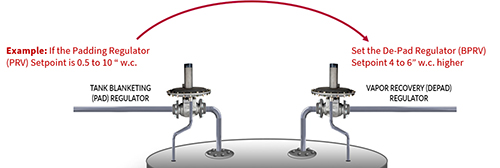
Example – if the padding (PRV) set point is 0.5 to 10″ WC, set the de-pad (BPRV) regulator 4 to 6″ WC higher.
Note: the vessels in this case study were relatively small. Larger-volume vessels will require larger valves with higher flow capability. For sanitary applications, see Steriflow’s full range of sanitary blanketing valves; for industrial, non-sanitary applications, see the Jordan Valve blanketing range.
Conclusion
Reliable nitrogen blanketing is essential to safe, compliant small molecule API production – protecting operators from toxic solvents, shielding product from oxygen and airborne contamination, and keeping flammable vapors contained. Achieving it depends on correctly pairing a padding valve (PRV) on the supply with a de-padding valve (BPRV) on the vent, each sized to the vessel’s pressure, flow, and process conditions. As this CDMO’s reactor and product hold vessels show, a single facility often needs different regulators for different vessels. Steriflow’s pharma-grade blanketing regulators, combined with API 2000 sizing support, let engineers match the right valve to each vessel and hold a stable, safe blanket throughout the process.
Key Takeaways
- Inert gas (nitrogen) blanketing protects operators, product and facility by excluding oxygen, containing toxic vapors, and preventing a flammable headspace
- Every blanketing loop pairs a padding valve (PRV) that adds gas on a pressure drop with a de-padding valve (BPRV) that relieves gas on a pressure rise
- Reactors and product hold vessels often operate at very different pressures – here, 15 psig versus 8″ WC – and need different regulators sized accordingly
- Steriflow’s JSRLP and JSRULP padding valves and JSBLP and Mark 958 de-padding valves covered both vessels in this application, all with Jorlon PTFE diaphragms
- Correct sizing requires liquid, temperature, vapor-pressure, vessel-volume, and flow data, evaluated against API STD 2000 for in-breathing and out-breathing
- The BPRV relief set point must always be set above the PRV supply set point; use the set-point guideline table to choose the margin
- Non-sanitary regulators may suffice for upstream small molecule API steps, while sanitary valves are generally required for formulation and biologic production – always confirm against your specifications
Need Help with This Application?
Our engineering team can help you size and select padding and de-padding regulators for your reactors, hold vessels, and storage tanks
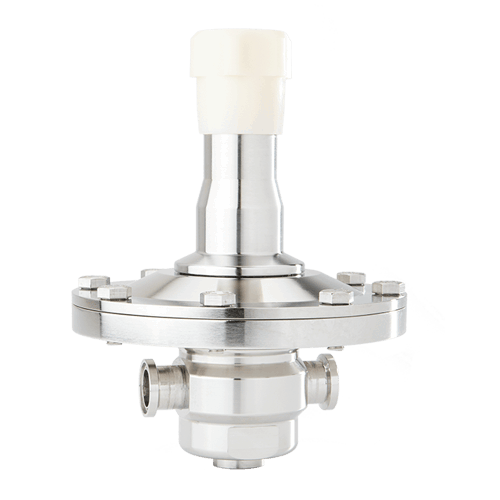 JSRLP Series
 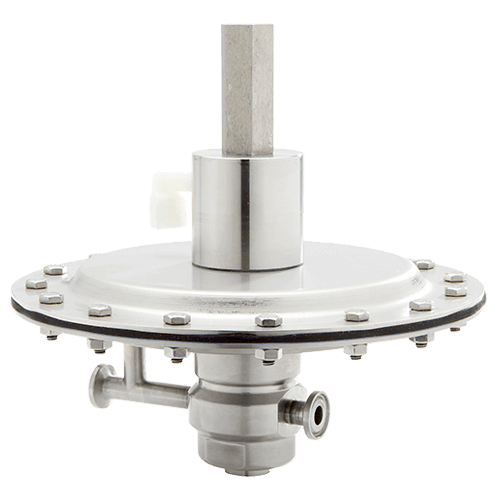 JSRULP Series
 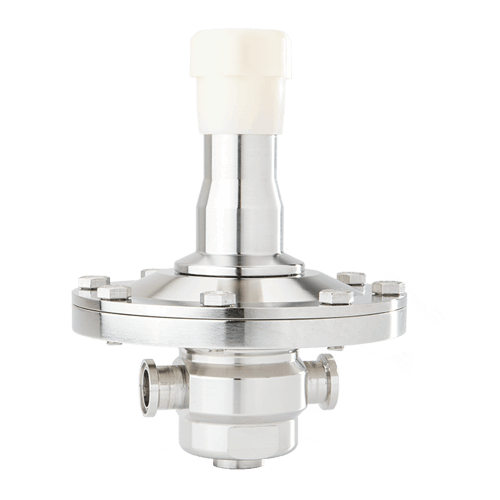 JSBLP Series
 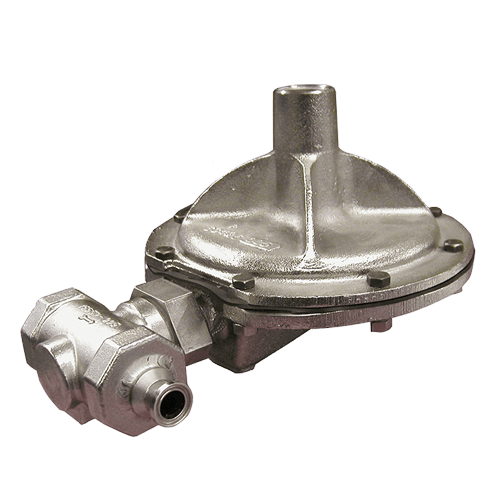 Mark 958 Series