


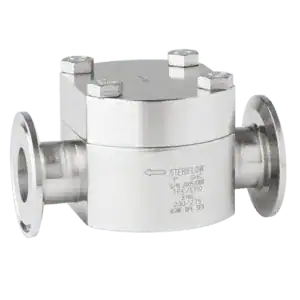
SHC Series ⟶
Horizontal line, Low to High Flow, Springless, Crevice-Free
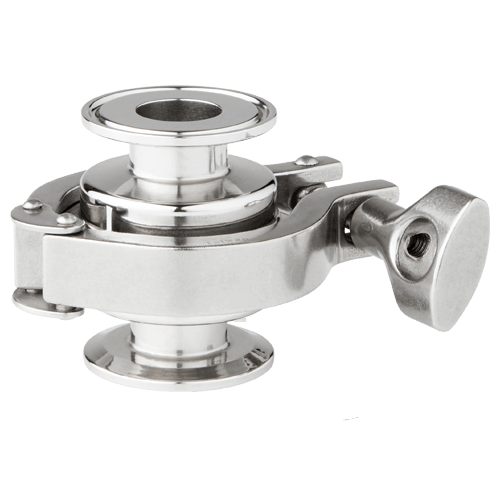
SVC Series – Down-Flow (Liquids only) ⟶
Vertical Line Down-Flow - For Liquid Drain Lines, Low to High Flow, Springless, Crevice-Free
SVC Series – Up-Flow ⟶
Vertical Line Up-Flow, Low to High Flow, Springless, Crevice-Free
Your List
Email List
Get A Quote
Steriflow Sanitary / Hygienic Check Valve
Steriflow developed the industry’s first check valve specifically for Water for Injection (WFI) and bioprocess lines.
The SVC and SHC Series feature a springless design that eliminates springs, sliding stems, and hinges, reducing potential particle entrapment and shedding.
Designed to ASME BPE guidelines, these sanitary check valves support Clean-in-Place (CIP), Sterilization-in-Place (SIP), and autoclaving.
Steriflow Sanitary Check Valve Series
SHC Series – Horizontal Flow
Designed for horizontal process lines, the SHC Series features a fully drainable body without flat horizontal wetted surfaces and offers multiple disc options.
Sizes: 1/2″-2″ (DN15–DN50)
SVC Series – Vertical Flow
- SVC Up-Flow: Designed for vertical up-flow applications with Teflon, PEEK, and stainless steel/EPDM disc options.
- SVC Down-Flow: Designed for liquid outlet and drain applications. Its floating disc prevents backflow and eliminates dead legs to help minimize contamination risks.
Sizes: 1/2″-4″ (DN15–DN100)
Applications of Sanitary Check / Non Return Valves
Sanitary check valves are essential components in industries where hygiene, safety, and process integrity are critical. Common applications include:
- Pharmaceutical and Biopharmaceutical Manufacturing: WFI systems, purification, and high-purity fluid transfer.
- Bioprocessing: Media and buffer preparation, process fluid distribution, and drainage.
- Food and Beverage Processing: Hygienic production lines requiring reliable backflow prevention.
Explore our complete range of sanitary valves for high-purity processing applications.
What Is a Springless Check Valve?
A springless check valve prevents reverse flow without using a spring to operate its disc. This design helps reduce crevices and potential sources of particulate generation in applications where process cleanliness is critical.