


Preventing Overpressure Events in Aseptic Process Vessels
Application: Upstream and downstream processing, process hold vessels
Media: Ambient WFI, buffer, media, process fluids
Valve Requirement: Overpressure prevention and relief
Overpressure in an aseptic vessel threatens equipment, personnel, and the sterility of the batch inside. Choosing the right relief device is a decision about more than set point and size. This page walks through how sanitary safety relief valves and sanitary rupture discs each work, how they compare on sterility risk, materials, space, testability, and cost, and how a bypass valve can keep an overpressure event from happening in the first place.
How can I prevent or mitigate overpressure events in my process vessels?
Overpressure events in aseptic vessels can be prevented by installing an overpressure relief device. In North America, ASME certifies and recognizes two devices commonly specified for sanitary service: sanitary safety relief valves (SRVs) and sanitary rupture discs.
Below picture: A sanitary safety relief valve installed on a process hold vessel.
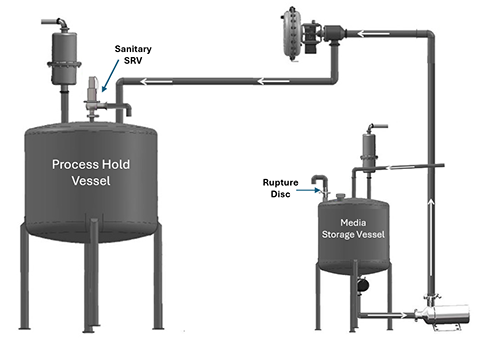
What is a sanitary safety relief valve and h ow does it work?
A safety relief valve is a mechanical safety device that opens to release excess pressure from pressurized equipment or vessels, then closes again once normal system pressure returns.
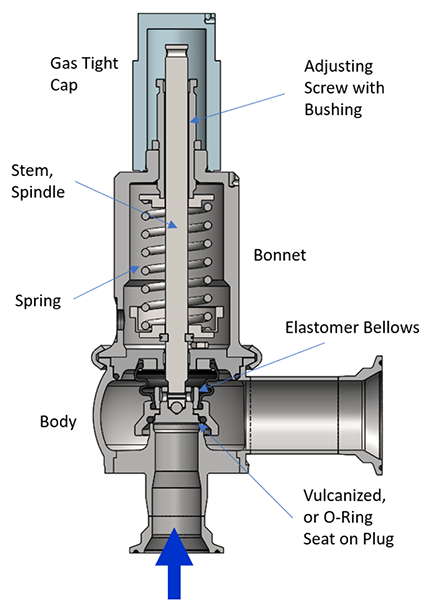
Opening
An SSRV opens when the pressure pushing against the bottom of the seat exceeds a fixed opposing spring force – the set point – plus any opposing back pressure force. ASME rules state that full opening must occur at a pressure no more than 10% above set point.
STERIFLOW ASME CERTIFIED TEST RESULTS:
- Lift off occurs at approximately 1% below set point
- Full open occurs at approximately 3-5% above set point
- Reseat occurs at pressures 8-9% below set point
Closing
An SSRV closes when the valve reseats after the release of pressure. The difference between set point and the pressure at which the valve reseats is called fixed blowdown, and it is not adjustable. Steriflow sanitary SRVs reseat at pressures 8-9% below set point.
What is a sanitary rupture disc and how does it work?
ASME defines a rupture disc device as a non-reclosing pressure relief device, actuated by inlet static pressure and designed to function by the bursting of a pressure-containing disc.
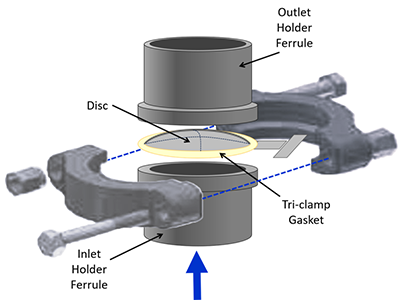
- Non-reclosing: rupture discs are single-use safety devices. They do not reseal or close after they burst.
- Actuation: rupture is triggered directly by the static pressure of the process fluid pushing against the inlet side of the disc.
- Burst tolerances: burst pressure is held to strict limits by code – within ±2 psi for marked pressures up to 40 psi, and ±5 % for pressures above 40 psi. Burst pressure is controlled by disc material, thickness, and the scoring or etching of the disc surface.
Which device should I use for a sterile process?
If your process is considered aseptic or sterile, a sanitary safety relief valve is usually the better choice, because it recloses while the vessel is still under pressure. Vessel pressure remains above atmospheric even as the valve closes, so no external contaminants can ingress. Risk of sterile batch loss is typically not a concern.
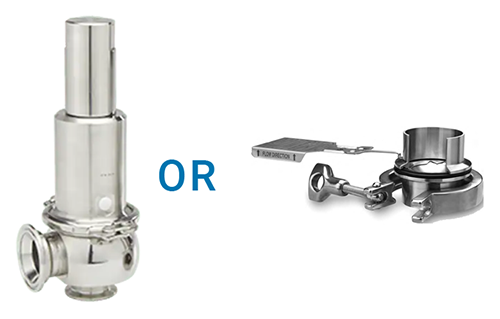
Sterility risk with rupture discs: once a rupture disc bursts during an overpressure excursion, it cannot close. The contents of the vessel are exposed to room contaminants and can no longer be considered sterile. The risk of batch contamination and loss is high.
Is the device material compatible with the contents of the vessel?
The metallic process-wetted components of a sanitary safety relief valve are machined from barstock, which is readily available in a wide range of exotic alloys.
The same is true of rupture disc holders. The burst disc itself, however, is manufactured from thin sheet metal or foil, and exotic material availability in those forms is limited. Some rupture disc manufacturers coat stainless steel discs with FDA and USP Class VI compliant fluoroplastic or thermoplastic materials to compensate.
What are the installation space requirements for these devices?
Rupture discs are usually smaller and lighter than an equivalently sized sanitary safety relief valve. Required installation head space and supported weight are both significantly less – a real consideration on tall vessels, in low-clearance suites, or on skids where headroom is already committed.
Can I test these devices periodically to confirm they are working correctly?
Sanitary safety relief valves are designed to be periodically tested, and ASME requires it. Sanitary SRVs must have either a manual or an automated lift device so the valve can be exercised and pressure relieved during testing.
Ruptured discs cannot be tested. Once a disc has ruptured, it must be replaced.
How do the two devices compare on cost?
Purchase cost: the individual unit purchase cost of a sanitary rupture disc is usually significantly lower than a sanitary safety relief valve sized for the same service.
Lifetime cost: The total lifetime cost of ownership of a sanitary safety relief valve is usually lower. Because sanitary rupture discs must be replaced after every overpressure event, total costs depends on the number of replacement discs purchased and the replacement labor required over the installed life of the device. The probability of batch contamination also has to be factored into the analysis – a lost batch of a sterile API intermediate or final drug product can run into the millions of dollars.
By contract, a sanitary SRV reseats and seals after an overpressure event, and the risk of sterile batch contamination is much lower. The cost of annual or biennial inspection and testing should be included in the comparison.
| Consideration | Sanitary Safety Relieve Valve | Sanitary Rupture Disc |
|---|---|---|
| Recloses after relief | Yes - reseats at 8-9% below set point | No - single use, must be replaced |
| Sterility after an event | Maintained; vessel stays above atmospheric pressure while closing | Lost; vessel contents exposed to room contaminants |
| Exotic material availability | Broad - wetted parts machined from barstock | Limited - disc formed from thin sheet or foil; coatings sometimes used |
| Installation space and weight | Larger and heavier; requires head space | Smaller and lighter |
| Periodic testing | Required by ASME; manual or automated lift device | Not possible |
| Purchase cost | Higher | Lower |
| Lifetime cost of ownership | Usually lower | Depends on replacement discs, labor and batch loss risk |
Is there a device that can reduce the probability of an overpressure event happening at all?
Yes. A valve designed specifically to bypass excess flow – and therefore excess pressure – to sterile containment can act before a rupture disc or sanitary SRV ever needs to.
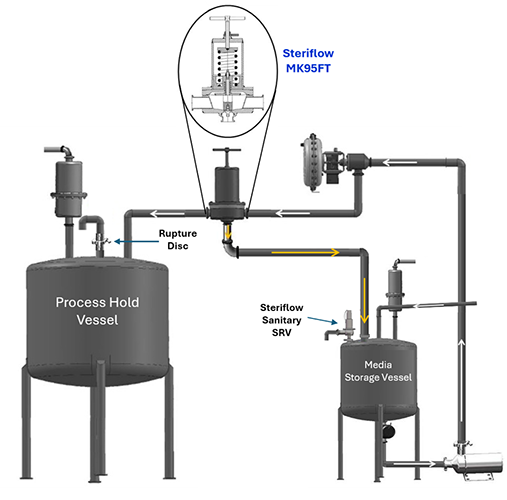
The above picture shows a Mark 95FT installed in a vessel feed line, diverting excess flow to sterile containment.
The Steriflow MK95FT overpressure bypass valve is a back pressure regulator with two inlets and a single bottom outlet. Installed in a line feeding a process vessel, it relieves pressure in excess of its set point through the bottom outlet. The MK95FT set point is placed above normal process operating pressure but below the set point of the rupture disc or safety relief valve.
In the installation shown above, excess flow is diverted back to a sterile containment vessel, preventing batch contamination and loss. Steriflow has supplied many MK95FT valves to customers for exactly this reason.
Key Takeaways
- Both sanitary safety relief valves and sanitary ruptured discs are ASME-recognized options for overpressure protection in sanitary service
- For aseptic and sterile processes, a sanitary SRV recloses under pressure and protects sterility; a burst rupture disc does not
- Rupture discs cost less per unit and take less space, but cannot be tested and must be replaced after every event
- Lifetime cost of ownership favors the SRV once replacement discs, labor, and the risk of a lost sterile batch are included
- A bypass valve such as the MK95FT can relieve excess pressure to sterile containment before either safety device activates
Let's Talk About Your Vessel Protection Strategy
Tell us your set points, media, and vessel configuration, and our team will help you select the right combination of relief and bypass devices
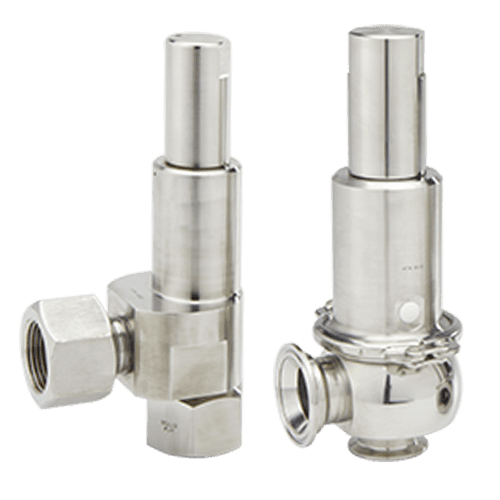 Sanitary Safety Relief Valves