


Aseptic Check Valves for WFI & Bioprocessing
Application: Biological API production (Upstream & Downstream); Chemical API; Parenteral formulation and fill
Media: WFI, Buffer, Bioprocess Fluids
Valve Requirement: WFI and bioprocess-service check valves (non-return valves)
A check valve, or non-return valve, has one job: allow flow in one direction and prevent it in the other. But in Water-for-Injection (WFI) and bioprocess service, that job is unforgiving – the valve must seal reliably against backflow while remaining fully drainable, crevice-free, and cleanable in place, without shedding particulate into the product. This application page looks at why traditional check valve designs fall short, and how Steriflow’s spring-free, floating-disc SVC and SHC valves were engineered to meet these demands.
Why Traditional Check Valves Fall Short
Ball, spring and spring-assisted poppet/disc check valves were adapted decades ago for hygienic food & beverage service, and have since been informally adopted by the pharma, nutraceutical, and supplement industries for non-parenteral (oral API) duties. But in biopharmaceutical and parenteral API manufacturing they are generally not accepted for WFI, drug additives, intermediates, or final drug product.
The reason is their internal geometry, which makes them hard to fully sanitize (rinse-CIP-rinse) or sterilize (SIP):
- They can’t fully drain – an integral dead leg or debris trap remains
- Most can’t achieve adequate CIP velocity or turbulence, and the spring introduces hold-up
- Ball and spring-loaded designs can shed particulate where the ball or disc contacts the seat
- Spring check valves add further limitations: material constraints, a process-wetted stem guide, variable cracking pressure, and pressure loss to compress the spring open

A Purpose-Built Aseptic Solution – The SVC and SHC
In 2009, Steriflow set out to solve these problems for the bio and parenteral pharma market. The result was the SVC (Steriflow Vertical Check Valve) and SHC (Steriflow Horizontal Check Valve), built at our Cincinnati, OH factory for service on WFI, buffers, bioprocess fluids, and intermediate and final drug product.
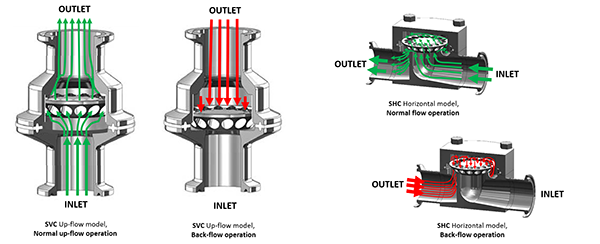
Both use an aseptic, floating-disc design – no guided stem, no spring. The disc self-guides within the upper body cavity, centered by flow moving around its perimeter and through angled holes in the disc face. That approach delivers:
- Minimal body-guide contact, which curtains particulate generation
- No crevices, enabling high-velocity, turbulent CIP throughout the valve
- A minuscule cracking pressure – once met, full flow is instantaneous with very little pressure loss
Disc Materials
Three disc materials are available for the SVC-upflow and SHC. All are FDA and USP Class VI compliant, ADI/TSE-free and both CIP and SIP-able.
| Disc Material | Cracking Pressure (no back pressure) |
|---|---|
| TFE | 0.04 psid (2,76 mbar) |
| PEEK | 0.04 psid (2,76 mbar) |
| 316 SS disc with EPDM O-ring | 0.13 psid (8,96 mbar) |
SVC-Downflow for Aseptic Drains
The SVC-Downflow is built for aseptic drain service, where the valve drains continuously and only closes when a water-based liquid rises through the outlet. Its low-density polypropylene disc (FDA, USP Class VI, ADI/TSE-free) needs no pressure to open – gravity holds it open at the bottom of the cavity – and on reverse flow it floats up on the rising liquid column and seals against the seat, preventing backflow into the classified space above. Like the other configurations, it is fully CIP- and SIP-capable.
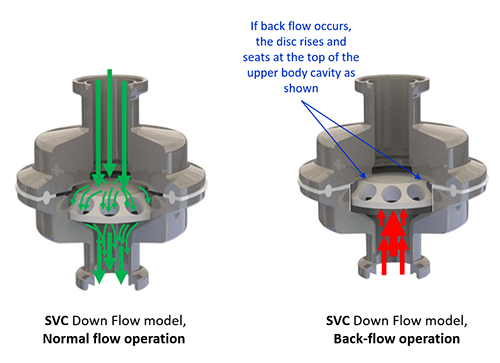
Sealing: All three configurations require differential pressure to close bubble-tight. Leak rates during back flow are summarized by valve size in the chart below.
Reverse Flow Leak Rate: 3 psi (20,7 mbar) Back Pressure*
| Model | Disc | Valve Size | Leakage ml/min |
|---|---|---|---|
| SVC (up-flow or down-flow) | PTFE, PEEK, Polypropylene | 1/2" - 1-1/2" | 1 |
| 2" | 0.8 | ||
| 2-1/2" - 4" | 1.1 | ||
| 316/EPDM | 1/2" - 4" | 0.1 | |
| SHC | PTFE, PEEK | 1/2" - 3/4" | 0.6 |
| 1" - 1-1/2" | 1 | ||
| 2" | 0.8 | ||
| 316/EPDM | 1/2" - 2" | 0.1 | |
| * | Leakage for all sizes and discs is bubble tight at 30 psig (2 barg) back pressure. Contact factory if leak data at additional back pressures is required. | ||
Applications
The SVC and SHC cover everything from clean-utility WFI through bioprocess service. A few common installations:
Clean Utilities – WFI
Hot & ambient WFI loops
After a hot-WFI POU or heat-exchanger outlet to prevent backflow into the loop; at pump-out, an SVC-Upflow or SHC with a precise disc hole can keep a standby pump circuit above 80°C.
Recommended: SVC-Downflow or SHC (SVC-Upflow for the standby-circuit case)
BioProcess – Drains & Bypass
Wet-sink drains, centrifuge & overflow-to-drain
Under-sink installs prevent drain backflow into ISO-classified space; bypass-drain installs keep non-spec fluid out of centrate vessels and process skids
Recommended: SVC-Downflow
BioProcess – UF/DF & Chromatography
Diluted-buffer & eluate protection
Prevent non-spec buffer from contaminating filtrate or entering a chromatography column, and prevent non-spec eluate from being collected
Recommended: SHC on buffer bypass; SVC-Downflow on eluate bypass-to-drain.
Key Takeaways
Traditional ball and spring check valves are generally not accepted for WFI or drug product – they can’t be fully drained, cleaned, or sterilized, and can shed particulate
Steriflow’s SVC and SHC use a spring-free, stem-free floating-disc design that eliminates crevices and dead legs and enables high-velocity CIP and full SIP
Cracking pressure is as low as 0.04 psid (TFE/PEEK), with full flow instantaneous once met and very little pressure loss
Three configurations – SVC-Upflow, SHC-Horizontal, and SVC-Downflow for continuous-drain service – cover clean-utility WFI through bioprocess applications. All discs are FDA/USP Class VI and ADI-TSE-free
Need Help with This Application?
Our engineering team can help you select and size the right SVC or SHC configuration for your WFI or bioprocess service
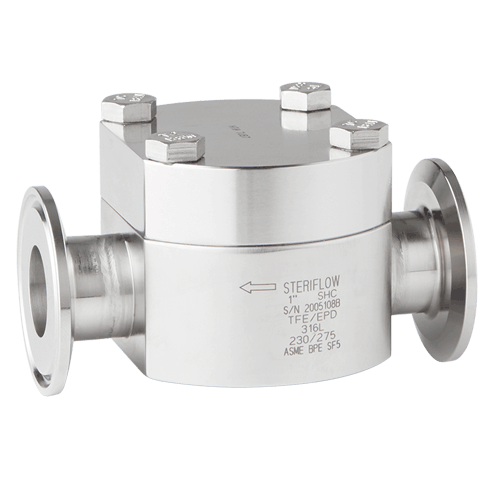 SHC Series Horizontal Check Valves
 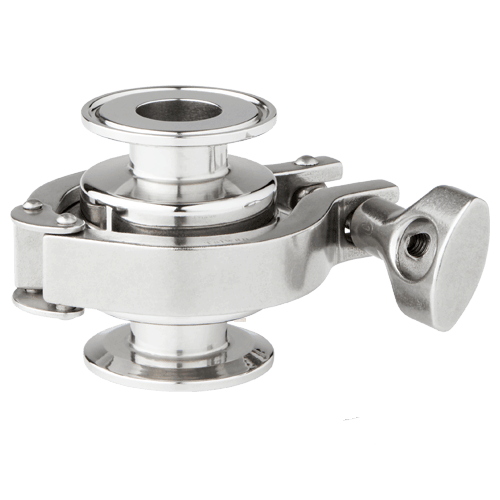 SVC Series Vertical Check Valves