


A Primer on Clean Steam Use in the Pharmaceutical Industry
Application: Clean Steam Generation, Distribution & Point of Use
Media: Clean Steam (Pure Steam), Clean Steam Condensate, USP Purified Water, WFI
Valve Requirement: Sanitary Pressure Reducing Valves (PRV), Clean Steam Traps, SIP Accessories, Sanitary Safety Relief Valves
Clean steam sterilizes the equipment that touches the drug product, humidifies the cleanrooms where that product is handled, and drives the autoclaves that sterilize everything else. Because it contacts product-contact surfaces directly, its purity is held to the same standard as the water used to make the drug itself. This primer covers what clean steam is, where it is used, and what its control requires – the first in a series that examines each of those processes in detail.
What is Clean Steam
Clean steam, called pure steam outside North America, is high-purity dry, saturated steam produced from purified water or water for injection (WFI). Unlike plan utility steam, it contains no boiler treatment chemicals and is suitable for direct contact with product-contact surfaces, sterile components, and cleanroom air.
| Characteristic | Requirement |
|---|---|
| Feedwater | USP Purified Water (USP-PW) or Water for Injection (WFI) |
| Feedwater Quality | Free from the corrosion inhibitors, amines, and oxygen scavengers found in plant utility steam. Generated from USP-PW - potable water passed through reverse osmosis and deionization - it is chemically pure H20 |
| Steam Quality | Must be dry, saturated steam: at the exact boiling point corresponding to its pressure, where water and steam are in thermal equilibrium. Not wet saturated steam carrying liquid droplets, and not superheated. Periodic steam quality testing is required. |
| Condensate Quality | Typically meets WFI standards for conductivity, total organic carbon (TOC), and bacterial endotoxins. Tested at the generator and at major points of use, usually at least weekly. |
Where is Clean Steam Used?
Requirements vary by product type and how the drug is administered to the patient.
| Product Type | Clean Steam Use |
|---|---|
| Biopharmaceuticals (large molecule APIs) | Required throughout upstream and downstream production to assure sterility of the API and final drug product. Includes monoclonal antibody immunotherapies and recombinant proteins such as recombinant DNA insulin. |
| Parenteral Small Molecule APIs | Required downstream to assure sterility of formulation, filtration, and filling equipment for bulk and drug containers. |
| Oral Small Molecule APIs | Not typically required for process lines or equipment, but often generated in these facilities to serve autoclaves and cleanroom humidification. |
| Liquid Nutraceuticals and Supplements | Regulated as foods. Not required upstream, clean or culinary stem is sometimes used downstream in sterile filtration, formulation, and filling to keep shelf-stable products free from contamination. |
| R & D Facilities | Same sterilization, humidifcation, and autoclave duties as production, at smaller generator capacity with more points of use. |
What Processes Use Clean Steam?
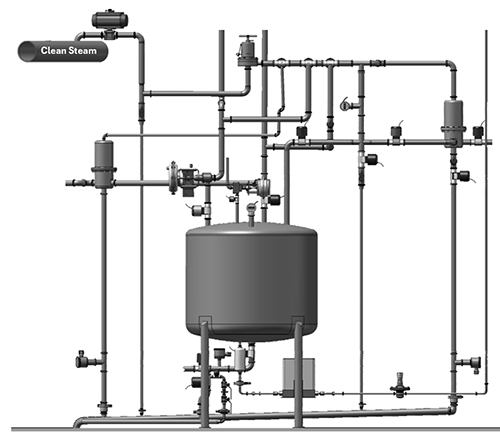
Steam in Place (SIP)
An automated, temperature-validated sterilization of all in-line tubing, vessels, pumps, sensors, and equipment that contact any process additive, intermediate, or final drug product. SIP is the most valve-intensive of the three processes: steam must be reduced to the validated sterilization pressure and held there, air displaced, and condensate removed from every low point so all surfaces reach and hold temperature for the full exposure period.
Cleanroom Humidification
Clean steam is injected directly into HVAC ductwork to hold specified humidity in ISO-classified cleanroom workspaces. Because it enters air that personnel and open product are exposed to, feedwater purity is non-negotiable and injection pressure must stay steady against continuously modulating demand.
Autoclaves
A steam-jacked pressure chamber with a sealed door, used to sterilize what cannot be sterilized in place – laboratory and production glassware, reusable stainless containers, mechanical cleanroom equipment, and sampling and instrumentation components. Units range from benchmark to room-sized.
Valve Requirements for Clean Steam Service
Every clean steam system shares a common set of control requirements between the generator and the point of use.
- Pressure reduction: A sanitary pressure reducing valve takes header pressure down to the validated setpoint at each drop and holds it as demand swings between idle and full SIP flow. Low offset matters – a regulator whose setpoint sags under increasing flow delivers a different saturation temperature than the cycle was validated at.
- Condensate removal: A clean steam trap built for sanitary service drains distribution piping and SIP circuits without pooling or dead legs, and drains fully on shutdown. Poor condensate removal is what pushes delivered steam off the saturation curve.
- Overpressure protection and cleanability: Vessels and filters downstream of a reducing station need relief sized and certified for the service. Every valve is also part of the sterile boundary, so wetted materials, surface finish, self-draining geometry, and documentation supporting validation are as much a part of selection as Cv and setpoint range.
Steriflow Valve regulators have been the most frequently specified valves in the world for clean steam pressure control since the company’s founding, and the Mark 96 Series – the first valve Steriflow built – remains the workhorse for reducing clean steam from overhead distribution pressure.
Specifying Clean Steam Valves for Your Facility?
Steriflow Valve application engineers work from your process conditions - header pressure, point-of-use setpoints, flow turndown, and validation requirements.
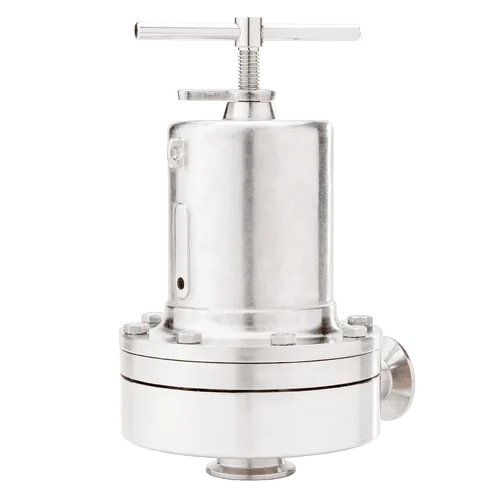 Mark 96 Series
 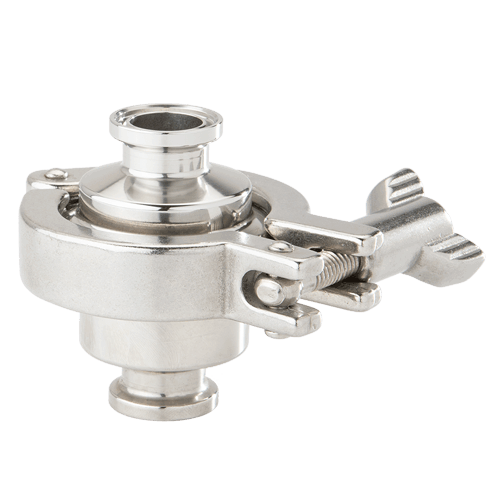 Mark 93 Series
 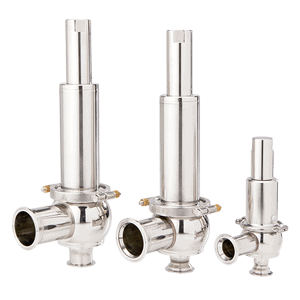 SSRV Series