


Precision Transmembrane Pressure (TMP) Control in Tangential Flow Filtration
Application: Downstream – Purification – TFF
Media: Ambient WFI, Buffer, Eluate Process Fluids
Valve Requirement: Retentate and Permeate Pressure Control
Tangential Flow Filtration (TFF) is widely used in biopharmaceutical manufacturing for ultrafiltration (UF), diafiltration (DF), concentration, and purification of biomolecules. During TFF, process fluid flows tangentially across a membrane surface, allowing smaller molecules and solvents to pass through while larger target molecules are retained and concentrated.
The performance of a TFF system is governed by Transmembrane Pressure (TMP), the pressure differential between the retentate and permeate sides of the membrane.
Figure 1. Simplified TFF Process Diagram
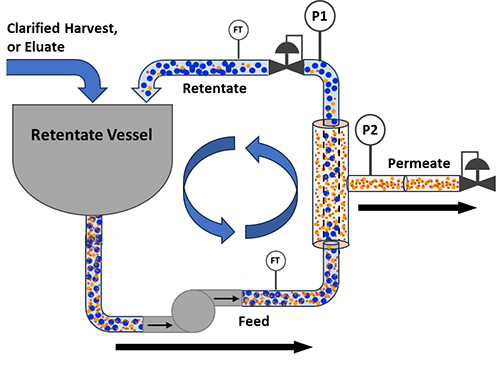
Maintaining an optimal TMP is one of the most important factors affecting filtration efficiency, membrane performance, processing time, and final product quality.
Why TMP Matters
TMP directly influences permeate flux, or the rate at which material passes through the membrane. Increasing TMP generally increases flux, but only to a point. Beyond the optimal operating range, higher pressures can accelerate membrane fouling, reduce filtration efficiency, and increase process variability.
Figure 2. Example Flux vs. TMP Relationship
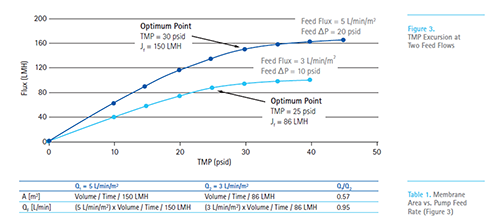
Process engineers carefully establish TMP operating windows during process development to balance productivity with membrane longevity. Operating outside of these limits can create several challenges:
- Reduced filtration efficiency
- Increased membrane fouling and gelling
- Longer processing times
- Increased shear exposure to sensitive biologics
- Potential loss of product quality and yield
As biologic therapies become more valuable and manufacturing processes move toward continuous operation, maintaining stable TMP control becomes increasingly important.
Traditional Methods of TMP Control
In many TFF systems, pressure is controlled on the retentate side of the membrane using a pressure control valve or back pressure regulator.
When the permeate vessel is vented to atmosphere, a single control device on the retentate outlet is typically sufficient. If the permeate stream is transferred directly into a downstream process operating under pressure, an additional control device may be required on the permeate side to maintain the desired TMP.
Multi-Use Stainless Steel Systems
Traditional stainless-steel TFF skids often utilize sanitary pressure control valves. While these valves can provide acceptable performance, their control range may become limited as flow conditions change throughout a filtration cycle.
Single-Use Systems
Single-use TFF systems have historically relied on tubing pinch valves for flow and pressure control. While simple in design, pinch valves can struggle to maintain stable TMP because pressure response is directly affected by tubing elasticity and the non-linear relationship between tubing compression and flow restriction.
As concentration increases during filtration and process conditions change, maintaining consistent pressure becomes increasingly difficult.
Improving TMP Control with Equilibar Technology
Equilibar® back pressure regulators provide an alternative approach to TMP control by directly regulating upstream pressure across an extremely wide operating range.
For multi-use stainless systems, the Equilibar FDO regulator delivers precise pressure control over flow turndown ratios up to 10,000:1. For single-use applications, the Equilibar SDO regulator provides the same operating principle in a disposable flow path configuration.
Figure 3. FDO Pressure Stability Performance
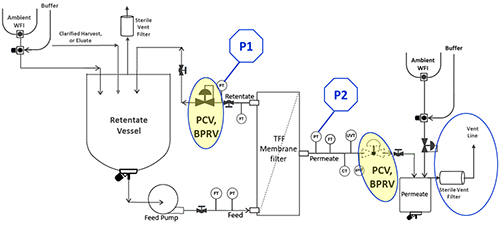
Unlike conventional control valves that continuously reposition a stem or actuator, Equilibar regulators maintain pressure through a force-balance design that responds immediately to process changes. This allows stable pressure control even when flow rates, fluid properties, or operating conditions vary significantly throughout a filtration run.
Single-Use TFF Performance Testing
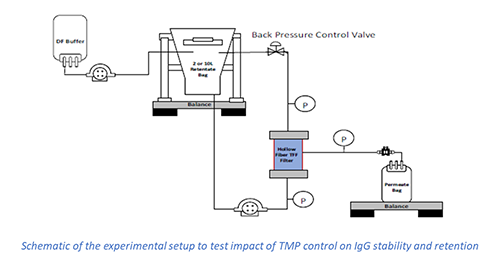
To evaluate TMP control performance in a realistic TFF environment, Equilibar compared the SDO single-use regulator against an industry-standard pinch valve using a laboratory ultrafiltration system.
The test maintained a target TMP while monitoring system stability and permeate flow performance.
Results showed that the Equilibar SDO maintained significantly tighter TMP control throughout the filtration process. The improved pressure stability also resulted in more consistent permeate flow rates and reduced process variability.
Figure 4. TMP Stability Comparison: SDO vs. Pinch Valve
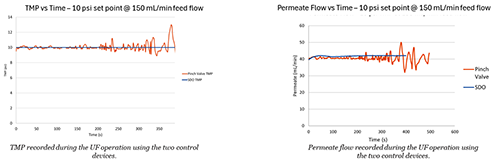
The difference stems from the operating principles of the two technologies. Pinch valves rely on mechanical compression of tubing, which introduces variability as tubing characteristics change. The Equilibar SDO continuously balances process pressure against pilot pressure, enabling rapid and proportional response to changing system conditions.
Impact on Product Recovery
Additional testing was performed using IgG concentration studies on an industry-standard single-use UF/DF platform.
The results demonstrated that improved TMP stability translated directly into process benefits, including:
- Reduced filtration cycle times
- Improved process consistency
- Lower product loss
- Better preservation of protein integrity
Figure 5. IgG Concentration Performance Results
Across multiple pump configurations, the Equilibar SDO consistently reduced variation in product concentration compared to traditional pinch valve control. Improved TMP stability also reduced processing time and helped minimize product loss during concentration steps.
Conclusion
TMP remains one of the most critical process variables in Tangential Flow Filtration. Stable pressure control improves filtration efficiency, protects membrane performance, and helps preserve valuable biologic products.
For both stainless-steel and single-use TFF systems, Equilibar pressure control technology provides a highly responsive alternative to conventional valves, delivering exceptional pressure stability across a wide operating range and helping manufacturers achieve more consistent, efficient filtration performance.
Key Takeaways
- Transmembrane Pressure (TMP) is the primary driver of TFF performance, directly affecting permeate flux, filtration efficiency, processing time, and product quality.
- Stable TMP control helps reduce membrane fouling and process variability, improving filter utilization and overall process consistency.
- Traditional pinch valves can introduce pressure fluctuations, particularly in single-use systems where changing tubing characteristics affect control performance.
- Equilibar FDO and SDO regulators provide precise pressure control across extremely wide flow ranges, enabling stable TMP throughout the entire filtration cycle.
- Improved TMP stability results in more consistent permeate flow, shorter processing times, and better product recovery.
- Testing demonstrated measurable improvements in protein retention and process performance, including reduced IgG loss and improved concentration consistency compared to pinch valve control.
- For both stainless-steel and single-use TFF systems, advanced pressure control can help maximize filtration efficiency while protecting valuable biologic products.
Need Help with this Application?
Our engineering team is available to help you evaluate precision TMP control for your TFF, UF, and DF processes
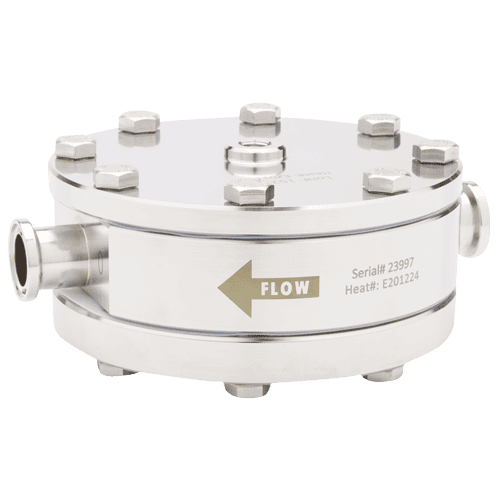 Equilibar FDO Series Back Pressure Regulator