


How Clean Steam Is Produced, Distributed, and Delivered
Application: Clean Steam Generation, Distribution Loop, Point of Use Sampling
Media: Clean Steam (Pure Steam), Clean Steam Condensate, USP Purified Water
Valve Requirement: Sanitary Ball Valves, Pressure Reducing Valves (PRV), Pressure Control Valves (PCV), Zero Static Diaphragm Valves, Clean Steam Traps, Sample Coolers & Sampling Valves
Between the clean steam generator and the surface being sterilized sits a distribution loop that can run the length of a biopharmaceutical plant. Every foot of it is an opportunity for steam to lose quality – pressure that drifts off setpoint, condensate that pools in a low point, a dead leg that cannot be drained. This page follows clean steam from generation to point of use and identifies the valve at each step.
How Clean Steam Is Generated
Clean steam is produced by boiling and evaporating USP Purified Water, usually in a plant-steam-fed heat exchanger called a Clean Steam Generator (CSG). Smaller generators may be electrically heated.
| Parameter | Typical Specification |
|---|---|
| Location | Clean Utility area of the plant |
| Construction | The heat exchanger and all tubing in clean steam contact is 316L stainless steel |
| Surface finish | Mechanical polish of <20 uim Ra. Electropolished finishes of <15 uin Ra are sometimes specified to improve corrosion resistance and provide a chromium-enriched passive layer |
| CSG head pressure | 45-90 psig (3 - 6 barg) |
| Distribution pressure | Typically 45 - 60 psig (3 -4 barg) depending on generator model, loop size, and customer specification |
Where Clean Steam Is Distributed
Clean steam is distributed to every major upstream and downstream production area for Steam in Place (SIP) sterilization – cell culture, harvest, purification, formulation, and fill/finish all require it. In a full-scale plant these distribution loops are very large. Clean steam also serves as the sterilization media for autoclaves and for the humidification of every ISO-classified cleanroom in the facility.
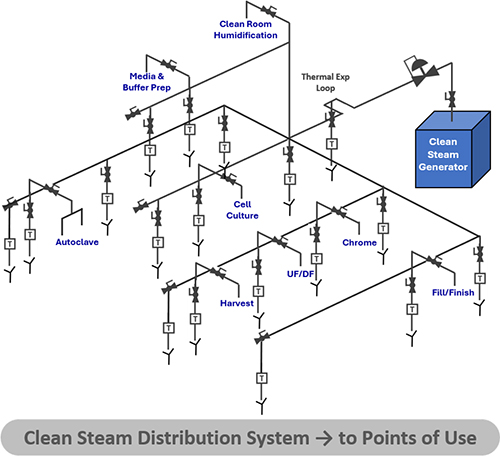
Getting Clean Steam to the Point of Use
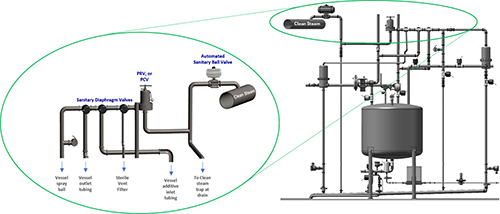
Steam is taken off the distribution loop through an automated sanitary ball valve. It exits the top of the distribution tubing – not the bottom, where condensate collects – and is directed to the underside inlet of a pressure reducing valve or pressure control valve.
- Pressure reduction: A self operated PRV such as the Mark 96 Series, or a pressure control valve such as the Mark 978 Series, reduces distribution pressure to the specific pressure and corresponding saturation temperature each point of use requires.
- Distribution on the skid: Downstream of the PRV or PCV, automated zero static access diaphragm valves direct steam to the various locations on the process skid.
Condensate Removal from Distribution Lines
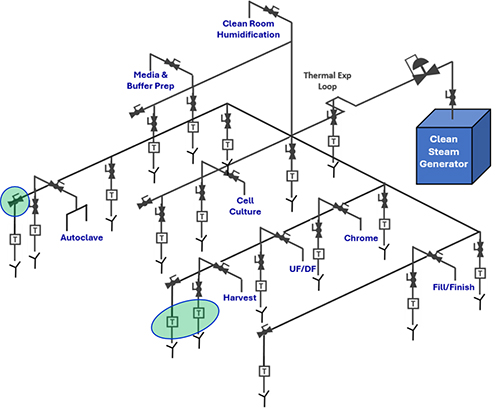
Condensate is removed from distribution tubing through drip legs placed every 25 to 50 feet at the bottom of the tubing, and at every end point in the line. Clean steam traps and specialty end-of-line ball valves with an integral drain port evacuate it.
Clean steam condensate is routed to drain and to the water reclamation systems. It is not returned as CSG feedwater – once it has passed through the distribution system it is considered contaminated.
Testing Condensate Quality
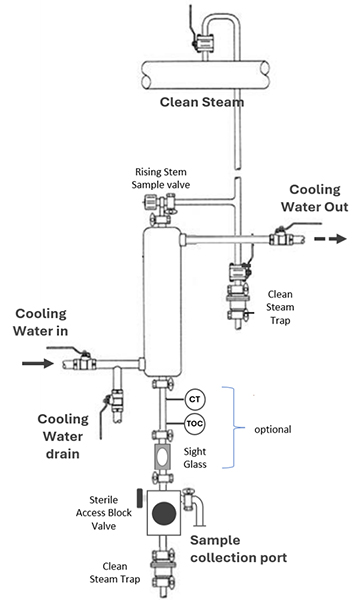
Clean steam condensate is a pharmaceutical water and must be tested for chemical and biological purity – at the CSG and at each major point of use across the loop. ISPE recommends weekly testing.
Sample collection centers on a sample cooler, a shell-and-spiral-tube heat exchanger, plus the accessory valves that bring steam down from the loop and the traps that clear condensate. Clean steam travels down from the overhead distribution line through an adjustable rising stem sampling valve into the cooler, where potable water chills the spiral tube bundle and condenses the steam to room-temperature water that is safe to sample. A sterile access block-and-bleed diaphragm valve is recommended to bypass cooled condensate after the cooler has been sterilized and before sampling, and balanced port thermostatic clean steam traps remove condensate from the assembly.
Designing or Expanding a Clean Steam Loop?
Steriflow Valve application engineers work from your distribution pressure, point-of-use setpoints, steam load, and validation requirements.