


Eliminating Pump Push-Through Flow with Pressure Driven Inline Buffer Dilution
Application: Downstream – Buffer Dilution
Media: Ambient WFI, Buffer, Ultrafiltrate, Diafiltrate
Valve Requirement: Flow Control Valves, Pressure Regulators
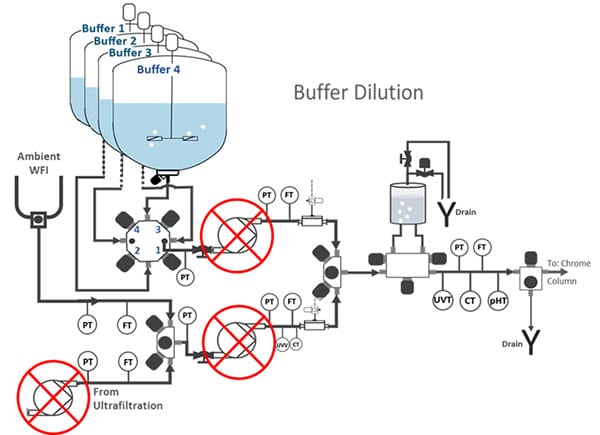
In previous discussions on this topic, we examined two methods used to minimize or eliminate PD pump push-through flow in a buffer dilution setting: using PRVs upstream of the pump to reduce elevated buffer head pressure, and using a special BPRV downstream of the pump to set discharge pressure slightly above the maximum buffer pump inlet head pressure to prevent push-through flow and stabilize pump head pressure.
This application page discusses how to eliminate push-through flow entirely by removing the pump and replacing it with pressure-driven flow. The objective is to increase buffer dilution accuracy, decreasing buffer waste, and reduce installation footprint – resulting in lower CapEx and OpEx.
Background: Pressure-Driven Flow in Biopharma
Pressure-driven flow is not a new technology. Gas pressure-driven flow has been used as a motive force in industrial chemical processes for decades and has been used in the biopharmaceutical industry (with sterile gas) since at least the early 1990s. In biopharma, it has traditionally been used in conjunction with N2 blanketing, or to move shear-sensitive process fluids from one vessel to another.
How does pressure-driven flow work in a biopharmaceutical context?
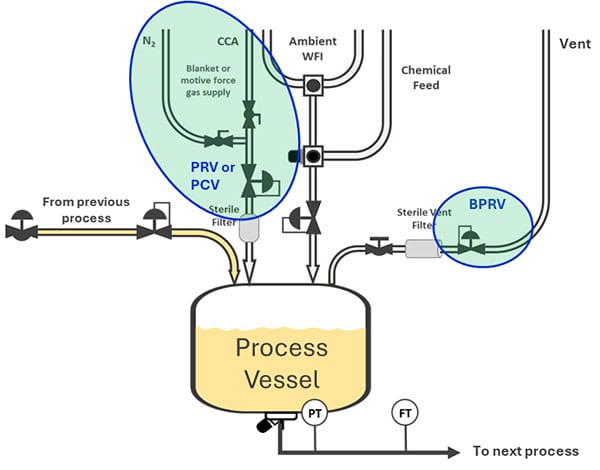
When it is time to move process fluid from a process vessel to another vessel, the headspace pressure is increased by adding N2 or clean compressed air via a Pressure Reducing Valve (PRV). the PRV opens and regulates headspace pressure to provide the motive force on top of the fluid column, achieving a specified flow rate. The pressure determines the flow rate.
When fluid is moved into the process vessel, a Back Pressure Regulating Valve (BPRV) installed on the process vessel vent line opens at a set point slightly above the PRV set point to allow headspace gas to escape as the process vessel fluid level rises.
Applying Pressure-Driven Flow to Inline Buffer Dilution
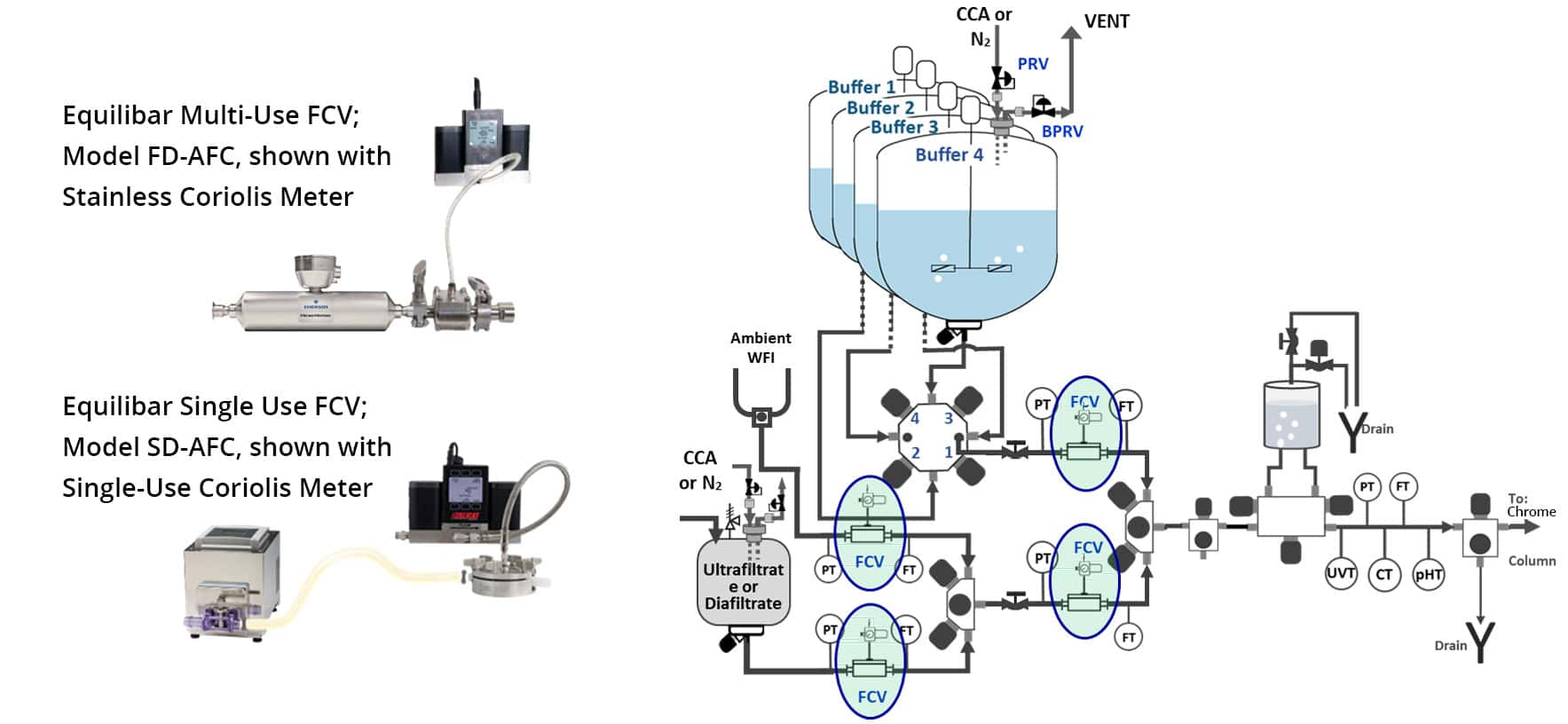
New technology has made it possible to apply this same pressure-driven flow concept to critical process applications such as Inline Buffer Dilution (ILD) – enabling gentile, precise metering of WFI, process fluids, and buffer from elevated or grade-level storage tanks directly to an inline dilution skid.
This approach makes a significant difference in buffer dilution quality. Because the pump is removed, both pump pulsation and push-through flow are eliminated. Both of those characteristics adversely affect dilution accuracy and increase the time required to obtain on-spec buffer.
Enabling Technology 1: Advanced Flow Control Valve
Traditional sanitary linear control valves lack the turndown and sensitivity required for this application. What makes pumpless ILD possible today is the advent of a new, precision flow control platform.
Equilibar developed a sanitary flow control valve based on its existing back pressure valve platform, delivering outstanding flow turndown (>100:1) and exceptional accuracy. Used in conjunction with modern Coriolis flow technology and precision vessel headspace gas regulators, this combination can exceed the accuracy and sensitivity achieved by conventional pump-based technology.
MULTI-USE
Equilibar Model FD-AFC
Multi-use flow control valve; shown above with stainless Coriolis meter. Precision flow control with >100:1 turndown for ILK applications
SINGLE USE
Equilibar Model SD-AFC
Single-use flow control valve; shown above with single-use Coriolis meter. Designed for flexible single-use bioprocess environments.
Read more on the Equilibar ILD Application Page
Enabling Technology 2: Next Generation Gas Regulator Platforms
Advances in pressure regulating technology are equally important to this application. Clean compressed gas PRVs and BPRVs are now available that can regulate very low to medium pressures at very low to high flow rates. Menu-driven automation is also possible, enabling on/off control of the ball valvves and precision pressure control with an I/P transducer – ensuring consistent headspace regardless of vessel fluid level.
PRV OPTIONS
Steriflow JSRLP / JSRULP Series
Low-pressure, clean gas pressure reducing valves for precise headspace pressure regulation. Available with automation-ready I/P option.
BPRV OPTIONS
Steriflow JSBLP / MK958 Series
Low-pressure back pressure regulators for vessel vent control. Maintains stable headspace gas balance during fluid transfer.
The combination of precision low-pressure gas regulators and advanced flow control valves provides the complete valve solution needed to implement a reliable pump-free buffer dilution system.
Performance: Flow Accuracy and Gradient Capability
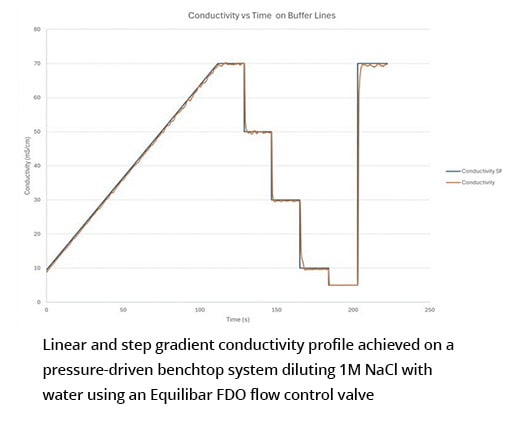
The gradient dilution data shown below was created using the Equilibar FDO flow control valve and pressurized flow. Both linear and step gradient conductivity profiles were achieved with excellent accuracy and repeatability, demonstrating the suitability of this approach for precision downstream bioprocessing.
The video link below demonstrates the FDO flow accuracy and turndown capabilities in a bench-scale pressure-driven dilution system.
Watch the FDO Flow Accuracy and Turndown Video
Engineering Takeaways
- Eliminating the pump removes both push-through flow and pulsation – two primary drivers of dilution inaccuracy
- Pressure-driven flow is a proven technology now available to critical ILD applications
- 100:1 turndown from advanced FCVs exceeds the performance of conventional pump-based systems
- Precision low-pressure gas regulators enable stable, automatable headspace control
- The net result is faster time-to-spec buffer, reduced waste, and a smaller installation footprint
- Lower CapEx and OpEx versus equivalent pump-based ILD systems
Bottom line: For biopharmaceutical operations seeking to improve Inline Buffer Dilution accuracy and reduce operating costs, pressure-driven flow-enabled by advanced FCVs and precision gas regulators from Steriflow and Equilibar – offers a compelling, pump-free alternatives.
Need Help With This Application?
Our engineering team is available to help you evaluate pressure-driven flow for your buffer dilution process.
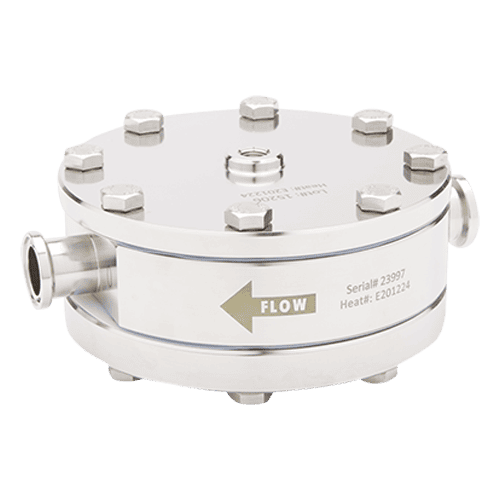 FDO Series
 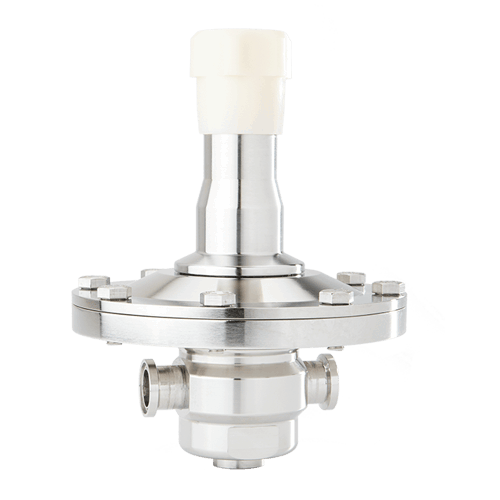 JSRLP Series
 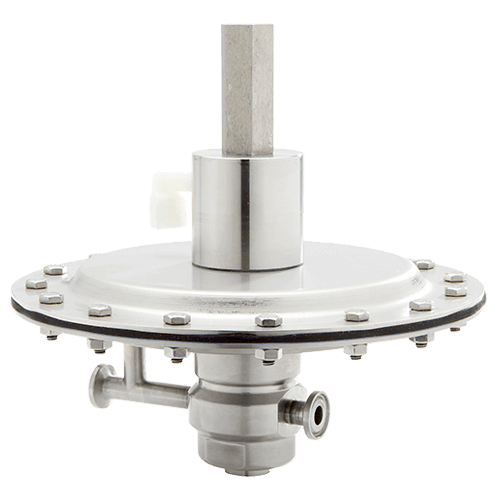 JSRULP Series
 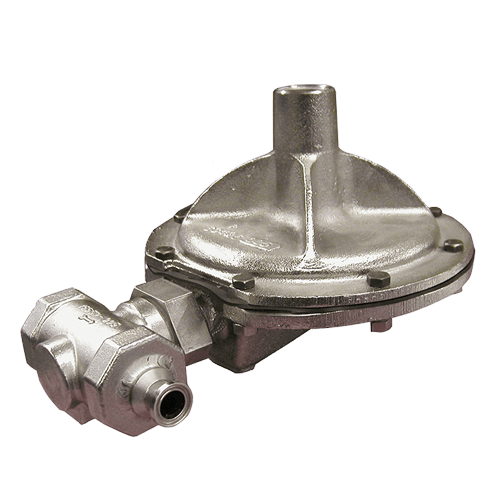 Mark 958 Series