


Automation of Pharma Clean Utility Systems
Application: Clean Utilities
Media: CIP fluids, USP PW, WFI, Clean Steam
Valve Requirement: PCV, PRV, Clean Steam Trap
Automation of Pharma Clean Utility Systems with Steriflow Sanitary Valves
In the pharmaceutical industry, maintaining cleanliness and sterility is crucial to meet strict regulatory standards. Clean utility systems for Clean-in-Place (CIP), USP purified water, hot WFI, and Sterilization-in-place (SIP) ensure that equipment such as tanks, tubing and equipment remain contamination-free before and between batches.
To improve efficiency, reliability, and scalability, many pharmaceutical companies prefer process automation for cleaning and sterilization. Automation enhances consistency, reduces human error, ensures better regulatory compliance, all while reducing cost.
When paired with advanced technologies such as Steriflow sanitary valves, automation optimizes the cleaning and sterilization processes. This post explores how the automation of these systems, combined with Steriflow valves, enhances operational efficiency, compliance and product quality in the pharmaceutical industry.
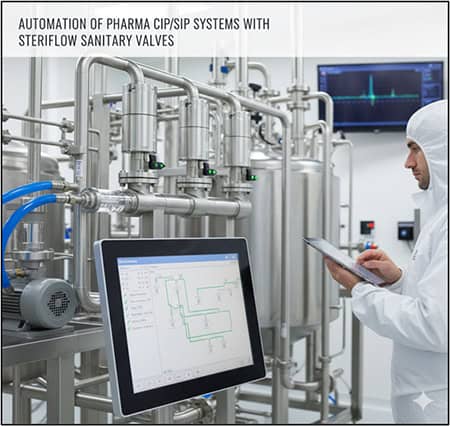
What are the Clean Utility Systems?
Clean utilities including Rinse, Clean-in-place (CIP), Sterilization-in-place (SIP), and Blow Down are integral processes in pharmaceutical production. These systems are designed to clean, sanitize, sterilize and dry all tubing, vessels, equipment, and components that come in direct or indirect contact with additives, and intermediate and final drug product, all without the need to dismantle it, thus minimizing the risk of contamination and reducing operations and maintenance costs.
The sanitization and sterilization steps are:
- 1st Rinse: a hot USP Purified Water (USP PW) rinse is the first step for sanitization of Pharma process equipment after batch. It removes any physical biological debris left in the production systems.
- CIP: CIP automates equipment cleaning without disassembly of equipment or valves. The process circulates detergents and sanitizing agents at high flow velocity to remove and sanitize product residues from tanks, pipes and valves. The process ensures that equipment is free from contaminants and biological residue.
- Final Rinse: a final, high velocity rinse with hot Water-for-injection (WFI) is circulated next. It ensures that all traces of the sanitization chemistry is removed from the production system.
- SIP Systems: After sanitization and rinse, the equipment is sterilized using high temperature steam or chemicals to ensure that no micro-organisms or bacteria are left behind.
- Blow down: Clean Sterile Air (sometimes called Nitrogen) is used to remove any remaining steam condensate. With all traces of water, bacteria and other micro-organisms cannot gain a foothold in the production system.
All of these processes are highly critical for maintaining product integrity, safety and quality. Their importance has driven the move toward more sophisticated, automated systems that ensure both thoroughness and efficiency.
Understanding Automated Clean Utility Systems in Pharmaceutical Facilities
Automation in these systems typically involves sensors, controllers and valves that work together to monitor, control and adjust the process parameters in real-time, ensuring optimal conditions for cleaning and sterilization. Traditionally, these systems were manually controlled, which was not only labor-intensive but also prone to inconsistencies. Today, automation brings significant improvements.
- Improved Consistency and Precision: Automation ensures that every stage of the cleaning and sterilization process is executed exactly as planned, eliminating variability and human error.
- Efficiency: Automated CIP/SIP systems can reduce cleaning times and optimize resource usage (water, cleaning agents, energy), leading to cost savings and faster turnaround times between batches.
- Regulatory Compliance: With automated systems, manufacturers can generate detailed logs of the time, flow rate and temperature of every cleaning and sterilization cycle, which are crucial for meeting compliance standards like FDA, cGMP (Good Manufacturing Practices), and ISO certifications. That data can also be directly tied to quality records for the next drug batch made in the equipment being sanitized and sterilized.
Critical Role of Sanitary Valves for Automation
Valves are the decision points, the final control elements, within every sanitization and sterilization system. They determine where fluids travel, when equipment is isolated, and how pressure and flow is managed. In an automated CIP/SIP system, for example, sanitary valves must satisfy multiple performance requirements simultaneously. Internally, they must feature smooth, crevice-free flow paths and full drainability to prevent residue accumulation.
Mechanically, they must withstand repeated exposure to high-temperature steam, rapid pressure changes (sometimes including vacuum), and aggressive cleaning agents. From an automation standpoint, valves must delver precise, repeatable actuation to ensure that validated cleaning sequences remain consistent over time.
Failure at the valve level can undermine the integrity of the entire CIP/SIP system, leading to extended downtime, revalidation efforts or contamination risk.
How Steriflow Sanitary Valves Enable Reliable CIP/SIP Automation
Steriflow sanitary valves, with their design and functionality, contribute to smoother, more efficient automated operations.
Integration with Control Systems: Steriflow Sanitary Control Valves or Air Loaded Pressure Reducing Valves integrate seamlessly with PLC/SCADA systems through pneumatic and electric actuators. Control valve position sensors provide real-time feedback for closed-loop control, allowing facility-wide automation from a single control room. with air-loaded regulators, feedback is already present in the form of pressure transmitter readings, and feedback to the PLC or Distributed Control System.
Steriflow Sanitary Pressure Reducing Valves that are spring actuated are not often the choice for automation of clean steam pressure reduction for SIP and USP, PW, CIP, and hot WFI without need to connect to PLC/SCADA systems. Power or air is not needed, as these valve pressure set point is set with spring force.
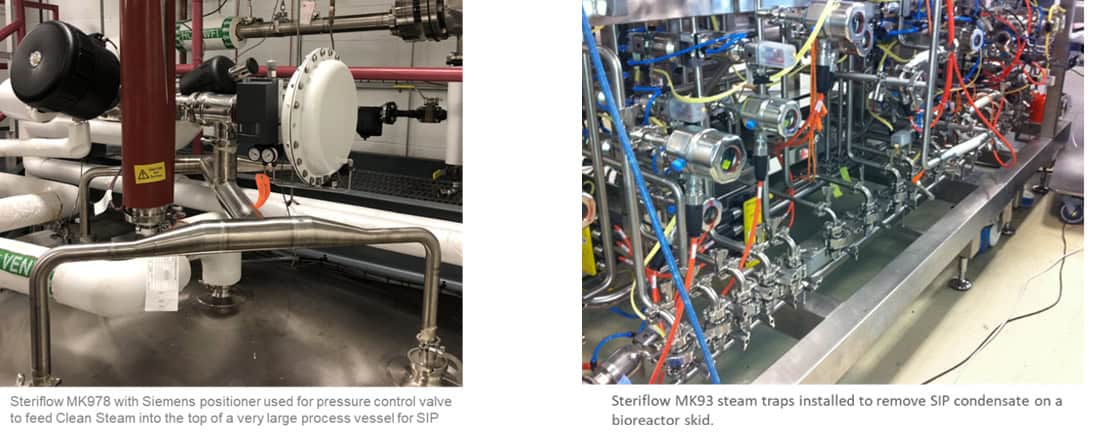
Automated Clean Condensate Removal: Steriflow’s low subcooling Clean Steam Traps ensure that SIP condensate is drained in a timely fashion without costly delays from temperature validation alarms.
Automated Sequencing: A typical CIP cycle: pre-rinse with USP-PW, alkaline wash, intermediate rinse, acid wash if needed, and final WFI rinse. Each step requires precise valve positioning and flow control. For SIP cycles, automated valves control steam introduction, pressure regulation, and cooling air or gas delivery with temperature sensors confirm sterilization parameters.
Data Logging and Validation: Automated systems log every valve position, pressure and temperature reading, flow rates, and cycle parameter. This documentation provides regulatory compliance and enables continuous improvement through performance analysis.
Benefits of Using Steriflow Valves in Automated CIP/SIP
Steriflow valves help pharmaceutical companies maintain high standards of regulatory compliance while enhancing efficiency and reducing the risk of contamination.
Operational Efficiency: Precise flow control reduces cycle times by 15-30%. Accurate chemical dosing minimizes consumption and wastewater costs. The Jorlon diaphragm lifetime durability warranty extends maintenance internals from months to years, reducing spare parts inventory and unplanned downtime.
Quality Assurance: Automated CIP/SIP with reliable valves delivers identical cycles every time. Elimination of manual valve manipulation removes human error. Steriflow Check Valves prevent cross-contamination and protect product integrity.
Regulatory Compliance: ISO 9001:2015 certified manufacturing ensures consistent quality. Steriflow valves meet the sanitary standards required by the FDA and cGMP guidelines, ensuring that every part of the CIP/SIP system is compliant with health and safety standards. Complete documentation supports validation protocols. Material certifications and test records satisfy GMP audits. The lifetime Jorlon warranty reduces control burden.
Best Practices for Implementing Steriflow Valves in Your CIP/SIP System
Following these best practices when implementing Steriflow valves in your CIP/SIP system will ensure optimal performance and reliability. Choose the right Steriflow Valve model: Select sanitary control valves (such as the Mark 978 Series or variants) or pressure reducing vales (such as the Mark 96 Series), and clean steam traps (such as the Mark 93) suited to your specific CIP/SIP flow, pressure, and media requirements.
Match Valve Characteristics to Process Needs: consider flow requirements (linear, equal percentage or custom trim) to ensure accurate regulation of pressure, flow rate, and other variables critical to CIP/SIP performance
Ensure Hygienic Construction: use valves with polished internal surfaces and sanitary design to support smooth, crevice-free fluid paths that aid thorough cleaning and sterilization
Verify Material and Seal Compatibility: confirm that wetted parts (stainless steel, FDA/USP-Class materials) and seals are appropriate for your system’s chemicals and temperatures.
Design for Self-Draining and Orientation Flexibility: implement valves with self-draining geometry and flexible installation orientations (vertical/horizontal) to reduce reside buildup.
Select the Right Automation Package: choose an automation package that ensures seamless integration with Steriflow valves, providing reliable control, monitoring, and validation for your CIP/SIP processes. The automation package should include components such as control panels, positioners, and communication systems designed for the pharmaceutical industry’s regulatory standards.
Provide Accurate Process Data for Sizing: work with valve suppliers to supply detailed flow, pressure, and media data to ensure proper valve sizing and reliable performance.
Implement Regular Maintenance and Testing: establish routine inspections, calibration, and functional tests to ensure valves continue performing at peak efficiency.
Take Control of Your CIP/SIP Systems with Steriflow’s Sanitary Valves and Automation
Maximize your CIP/SIP system’s performance by choosing Steriflow sanitary valves fand automation solutions. Experience unmatched precision, reliability, and seamless integration to boost your cleaning and sterilization processes. Don’t settle for less; take control of your operations today with Steriflow valves and automation packages. Get in touch now and start optimizing your pharmaceutical systems with Steriflow!
Talk to Our Engineers!
We want to solve your application problems.